Insulation slows heat. Air sealing stops the air that carries it. In a Utah winter you need both, and the order matters.
Lehi Elite Insulation seals the attic floors of homes across Lehi and Utah County: top plates, recessed can lights, plumbing and flue chases, bath fan housings, wiring holes, and the attic hatch. We do it before new insulation goes in, as part of every attic job, and as a standalone job for houses that are insulated but still drafty. Free inspection, flat written price.
Takes about 30–45 minutes. No cost, no pressure.
Heated air rises and pushes out through the ceiling. Cold air gets pulled in low to replace it. That loop is the stack effect, and it runs harder the colder the night gets.
Utah County winter nights sit in the teens and single digits. Inside, the furnace keeps the house at 68. That temperature difference is the engine. Warm air finds every gap in the ceiling plane and leaves through the attic. Every cubic foot that leaves gets replaced by a cubic foot of cold air drawn in through the rim joist, the crawl space, the garage wall, and the gaps around pipes and wires at the bottom of the house.
Insulation does not stop this. Blown fiberglass and cellulose slow heat moving through them, but air moves through and around them easily. Sixteen inches of insulation over a leaking attic floor still leaks, it just leaks a slightly longer path. That is why we seal before we blow, every time, and why a house that is already at R-49 can still be drafty and still get ice dams.
The attic floor is the right place to attack it because it is the top of the loop, it is accessible, and the leaks are concentrated in a few predictable spots.
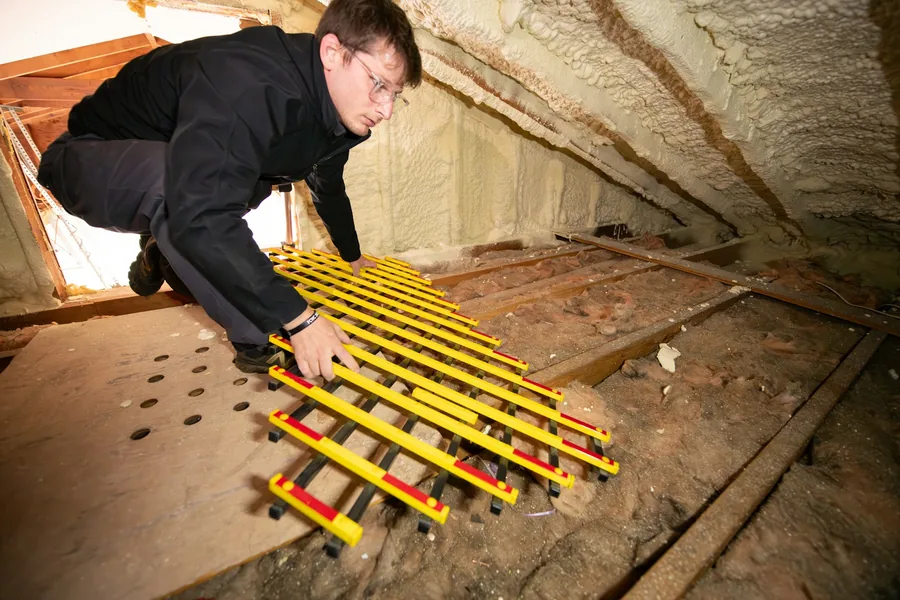
The same handful of details leak in nearly every house. The material changes by spot: sealant, foam, rigid board, or fire-rated products near heat.
The attic floor is only bare once. Sealing it is cheapest and most thorough when the insulation is being added anyway, which is why it is included on every attic insulation job we run.
When an attic already has a thick layer, the crew moves the insulation aside at each leak point, seals it, and puts the insulation back. It is slower and the quote reflects that, but it is still the right fix for a drafty, well-insulated house. After an insulation removal, the floor is completely bare and the sealing is as thorough as it ever gets.
Rafter baffles at the eaves and insulation dams around the hatch are part of the same visit. Baffles keep the soffit vents open so the attic breathes correctly once it is sealed from below. Dams keep the insulation from spilling into the hatch opening.
A blower door measures how leaky the whole house is before and after. It is useful on larger jobs and sometimes required by rebate specifications. Whether your job includes one depends on the scope and the current ThermWise specification, and we tell you when we quote.
Amounts set by the utilities and subject to change. Source: Enbridge Gas ThermWise. Full guide and eligibility checker. Last checked September 30, 2026.
We walk the attic and map the leak points: top plates, cans, chases, flues, hatch. We note anything that needs a fire-rated detail or a re-ducted fan. About 30–45 minutes.
Every leak point listed, the material for each, whether insulation is being added or moved aside, and the rebate you qualify for. Flat, in writing.
Walkways protected. Each detail sealed with the right product. Can light covers, chase blocking, flue collars, hatch cover installed. Baffles and dams set.
Photos of every sealed detail, blower door numbers if tested, and the documentation a rebate application asks for.
Usually it is done together with attic insulation, because the attic floor is only accessible once and sealing it is cheapest while the insulation is being added anyway. On its own it is still worth it when the attic is already at R-49 but the house is drafty, or when ice dams keep forming on a well-insulated roof. Those are air leakage problems, not insulation depth problems.
Yes, in theory, and almost never in practice for an older Lehi home. Air sealing an attic floor closes the big leaks that let conditioned air escape; it does not make a 1985 house airtight. Where a job is large enough to change how the house breathes, we talk about mechanical ventilation before we start, not after.
ThermWise requires air sealing to be done by an authorized contractor and to meet its air-sealing specifications. Whether a test is part of that depends on the current program specification, which Enbridge sets and changes. Confirm with Enbridge before the job, and we will tell you what the specification calls for when we quote.
Warm air rises. In winter, heated air pushes up through every gap in the ceiling into the attic, and cold outside air gets pulled in low through the rim joist, the crawl space, and gaps around the foundation to replace it. The taller the house and the colder the night, the stronger the pull. Sealing the top of the house, the attic floor, is the most effective place to interrupt it.
It is the main fix for them. Ice dams form when heat leaking into the attic melts snow on the roof, which refreezes at the cold eaves. Sealing the leaks and insulating to depth keeps the roof deck cold so the snow stays snow. Proper eave baffles and ventilation finish the job.
We map the leak points on your attic floor, show you the photos, and quote the sealing and the insulation together. In writing, flat priced.
Call (801) 348-3113Mon–Fri 7am–6pm. We'll call you back to schedule.