Free inspections  ·  Flat written pricing  ·  Utah County
Mon–Fri 7am–6pm  ·  Saturday by appointment
Lehi · Utah County · Climate Zone 5B

Spray Foam Insulation in Lehi, Utah

Air barrier and insulation in one step. Excellent where it belongs, a waste of money where it doesn't. We will tell you which is which.

Lehi Elite Insulation installs open-cell and closed-cell spray foam for homes across Lehi and Utah County: rim joists, vaulted and cathedral ceilings, bonus rooms over garages, unvented attic assemblies, crawl space walls, and detached shops and metal buildings. Free inspection, a candid recommendation, and a flat written price.

  • ✓ Open or closed cell chosen for the assembly, not for the truck
  • ✓ Honest about where blown insulation does the job for less
  • ✓ Product re-occupancy time told to you before the job, not after

Get a free inspection

Takes about 30–45 minutes. No cost, no pressure.

We'll call you back to schedule. Your request goes only to the contractor who does the work. See our privacy policy.

Thanks, we'll call you back shortly.
What it does

Spray foam is an air barrier that happens to insulate

Every other insulation product slows heat. Spray foam also stops air, and in a Utah house that is usually the bigger problem.

Two liquid components mix at the spray gun, expand on contact, and cure into a rigid or semi-rigid foam that bonds to whatever it touches. Because it expands into every gap, it seals the assembly at the same time it insulates it. There are no seams, no compression, and no gaps at the edges where batts and blown products lose their rating.

That is why foam is the right answer for the parts of a Lehi home where air leakage does the damage: the rim joist band where the foundation meets the floor framing, vaulted ceilings with no room for 16 inches of loose fill, floor cavities over an unheated garage, and any assembly that touches concrete or metal and needs a vapor retarder built in.

It is also why foam is the wrong answer for a plain vented attic floor with good access. Blown insulation over a sealed attic floor reaches R-49 for a fraction of the cost, and the air sealing gets done with sealant where the leaks actually are.

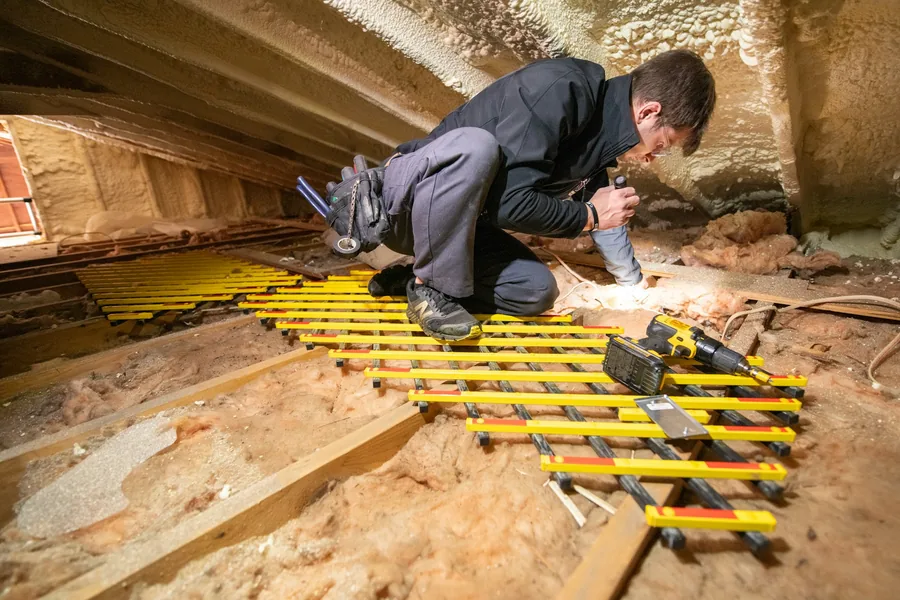
Worker applying insulation in a tight framed cavity
Foam fills the cavity edge to edge and seals against the framing as it cures. Stock photo.
Open vs. closed cell

Two products, two jobs

The names describe the foam's cell structure. Closed cells are sealed and hold gas, which is why closed-cell foam is denser, stiffer, and insulates more per inch.

FactorOpen-cell spray foamClosed-cell spray foam
R-value per inch (typical manufacturer rating)About R-3.5 to R-3.8About R-6 to R-7
DensityAbout 0.5 lb per cubic foot, soft and spongyAbout 2 lb per cubic foot, rigid
Air barrierYes, at adequate thicknessYes, at about 1 inch
Vapor retarderNo. Vapor passes through. Needs a separate retarder in some assemblies.Yes, at about 2 inches. Built in.
MoistureAbsorbs water if wettedRejects water. Can go against concrete and metal.
Structural stiffnessNone to speak ofAdds racking strength to framing and metal panels
SoundGood sound dampingFair
Cost per inchLowerHigher, but fewer inches needed
Best fit in a Lehi homeVaulted ceilings with depth to spare, interior walls, bonus room ceilings, sound controlRim joists, crawl space walls, metal buildings and shops, thin cavities, anything touching concrete

R-value ranges are typical manufacturer-rated values and vary by product and installed thickness. The product data sheet for the foam used on your job is what the inspector goes by.

Where it earns its price

Where spray foam makes sense in Utah County homes

Rim joists and sill plates

The band of framing where the foundation meets the floor is the coldest, leakiest detail in most Lehi basements. Two inches of closed-cell foam seals and insulates it in one pass. It is standard on every basement insulation job we run.

Vaulted and cathedral ceilings

No attic above, so no room for loose fill. Foam between the rafters gets a real R-value into a shallow cavity and seals the ceiling plane at the same time.

Bonus rooms over garages

The classic cold room. The floor cavity is open to an unheated garage and air moves through it. Closed-cell foam on the underside of the subfloor fixes what batts never do.

Unvented attic assemblies

Foam on the underside of the roof deck brings the attic inside the conditioned envelope. Right for homes with HVAC equipment and ducts in the attic. Utah's amended code includes provisions for unvented assemblies, and the details depend on your roof, so we check that before quoting.

Shops, pole barns, and metal buildings

Metal panels sweat in a Utah winter. Closed-cell foam bonded to the panel stops the condensation, stiffens the wall, and insulates it. The go-to for detached shops on the west side of Lehi and out toward Saratoga Springs and Eagle Mountain.

Crawl space walls

Closed-cell foam on the foundation wall of a crawl space rejects moisture, meets the R-15 continuous path in Utah's code, and seals the rim joist above it in the same visit.

Candidly

Where spray foam doesn't make sense

A contractor who sells foam for everything is selling foam, not solving your problem. Here is where we steer people elsewhere.

  • A vented attic floor with good access. Air seal the floor with sealant, blow fiberglass or cellulose to R-49 or R-60. Same performance, much lower cost.
  • Over existing blown insulation. Foam needs a clean surface to bond to. It does not go on top of loose fill.
  • Closed walls in an older home. Foam cannot be sprayed into a closed cavity through a hole. That is a dense-pack or injection foam job. See wall insulation.
  • Around old knob-and-tube wiring. Any insulation that buries live knob-and-tube is a fire risk. The wiring gets replaced first.
  • Anywhere a future trade needs access. Foam is permanent. Plumbing and wiring buried in it are hard to reach later. We plan around that.

Ventilation and re-entry

Spray foam off-gasses while it cures and the house needs to be ventilated during and after the spray. The product manufacturer publishes a re-occupancy time for the sprayed area, and the crew gives you that number before the job starts. Plan to be out of the sprayed area for at least the day. Sealing a house tighter also changes how it breathes, and if the job is large we talk about mechanical ventilation before we spray.

Process

How a foam job runs

Inspection. We look at the assembly, check for moisture, wiring, and anything that has to be handled first, and confirm which product and thickness meets code for that spot.

Written scope and price. Product, thickness, area, prep, and any rebate you qualify for, in writing, flat priced.

Prep. Surfaces cleaned and dry, adjacent areas masked, ventilation set up, occupants out of the sprayed area.

Spray. Foam applied in lifts to the specified thickness. Thickness is verified, not eyeballed.

Walkthrough. Photos, thickness readings, the product data sheet for your records, and the documentation a rebate application asks for.

Rebates. ThermWise rebates are based on R-value added to walls, floors, and attics, and on air sealing, not on the material. Foam that meets the increments can qualify for Enbridge Gas customers through a ThermWise authorized contractor. See the rebates guide.
Common questions

Spray foam insulation in Lehi, UT: FAQs

Open or closed cell for my home?

Closed cell for anything that touches concrete or needs a vapor retarder and structural stiffness: rim joists, crawl space walls, metal buildings, and thin cavities where you need the most R-value per inch. Open cell for interior applications where you want sound damping and a lower cost per inch: vaulted ceilings with adequate depth, interior walls, and bonus rooms. We pick based on the assembly, not on which product the truck happens to carry.

Is spray foam worth it in Utah's climate?

In the right spot, yes. Utah County's dry, cold winters and hot summers punish air leaks more than they punish thin insulation. Spray foam seals and insulates in one step, so it earns its price where air leakage is the main problem: rim joists, vaulted ceilings, and rooms over garages. In a plain vented attic with good access, blown insulation over a sealed floor gets you to R-49 for a lot less money, and we will say so.

Can spray foam go in an attic that already has blown insulation?

Not on the attic floor, no. Foam needs a clean surface to bond to, and spraying over loose fill traps it. If the plan is to convert a vented attic to an unvented one, the old insulation comes out first and the foam goes on the underside of the roof deck instead. That is a different job with different code rules, and we walk you through them.

How long before we can go back in the house?

Spray foam off-gasses while it cures. The re-entry time depends on the product, the amount sprayed, and ventilation. The manufacturer of the product used on your job publishes a re-occupancy time, and the crew tells you that number before the job starts. Plan to be out of the sprayed area for the day at minimum.

Does spray foam qualify for ThermWise rebates?

ThermWise rebates are based on the R-value added to walls, floors, and attics and on air sealing, not on the material. Foam that meets the R-value increments can qualify for Enbridge Gas customers through a ThermWise authorized contractor. Rim joist foam by itself is usually too small an area to be worth an application, but it is the best air sealing you can buy for the dollar.

Will spray foam stop cold floors over a garage?

It is the best tool for that job. A bonus room over a garage is cold because the floor cavity is open to the garage ceiling and air moves through it. Closed-cell foam on the underside of the subfloor, in the cavities between the joists, seals the air path and insulates in one step. Batts alone in that location rarely fix it.

Related

Other work that often goes with this

Free inspection

Find out if foam is the right tool for your problem

We look at the assembly, tell you straight whether spray foam or something cheaper solves it, and put the price in writing.

Call (801) 348-3113

Request a callback

Mon–Fri 7am–6pm. We'll call you back to schedule.

Thanks, we'll call you back shortly.
Call (801) 348-3113 for a Free Inspection